
 AI Tools
 Health
 Math
Math Everyday Life
 Finance
 Physics
 Chemistry
 Statistics
 Construction
 Pets
Pets Time & Date
 Conversion Calculator
 Sign In
Pages
Category
Follow Us On:
Pages
Category
Follow Us On:
Enter the first number, common difference, and the nth number in the arithmetic series calculator and find the nth term of an arithmetic sequence.
Related
The Arithmetic Sequence Calculator helps you find the nth term and the sum of the first n terms of an arithmetic sequence. By entering the first term, common difference (d), and the number of terms, you can instantly compute accurate results along with step-by-step solutions.
In mathematics:
An arithmetic sequence is a sequence of numbers in which each term is obtained by adding a constant value (called the common difference) to the previous term.
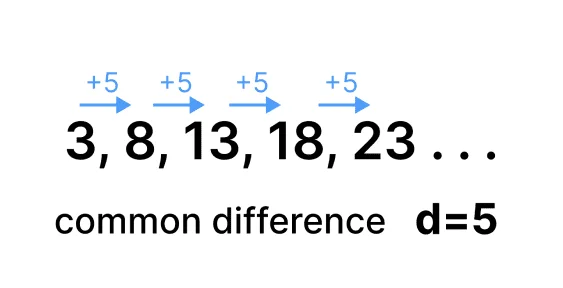
The constant value is denoted by d. The sequence can increase (if d is positive) or decrease (if d is negative). Arithmetic sequence, arithmetic series, and arithmetic progression are closely related terms.
an = a1 + (n − 1)d
Sn = (n / 2) [2a1 + (n − 1)d]
Where:
Find the 9th term of the sequence: 3, 8, 13, 18, 23, ...
Step 1: Identify values
Step 2: Apply the formula
a9 = 3 + (9 − 1) × 5
a9 = 3 + 8 × 5
a9 = 3 + 40
a9 = 43
Final Answer: The 9th term is 43.
Find the sum of the first 10 terms of the sequence: 1, 4, 7, 10, ...
Step 1: Identify values
Step 2: Apply the formula
S10 = (10 / 2) [2(1) + (10 − 1) × 3]
S10 = 5 [2 + 27]
S10 = 5 × 29
S10 = 145
Final Answer: The sum of the first 10 terms is 145.
An arithmetic sequence does not have a finite sum to infinity unless the common difference d = 0. If d ≠ 0, the terms continue increasing or decreasing indefinitely, and the series diverges.
Consider a sequence where a1 = 5 and d = 4:
| n | an |
|---|---|
| 1 | 5 |
| 2 | 9 |
| 3 | 13 |
| 4 | 17 |
| 5 | 21 |
| 10 | 41 |
| 20 | 81 |
| 30 | 121 |
| 40 | 161 |
Simply enter the first term, common difference, and number of terms to compute results quickly and efficiently.
Related
Add this calculator to your site.
×Just copy a given code & paste it right now into your website HTML (source) for suitable page.
Preview:



Easter into Action, Save With Satisfaction
UPTO
50 %
OFF
Give Us Your Feedback
Share Result
Arithmetic Sequence Calculator

Links
Home Conversion Calculator About Calculator Online Blog Hire Us Knowledge Base Sitemap Sitemap TwoEmail us at
Contact Us© Copyrights 2026 by Calculator-Online.net
