
 AI Tools
 Health
 Math
Math Everyday Life
 Finance
 Physics
 Chemistry
 Statistics
 Construction
 Pets
Pets Time & Date
 Conversion Calculator
 Sign In
Pages
Category
Follow Us On:
Pages
Category
Follow Us On:
Enter the quadratic function into the calculator to determine its axis of symmetry, along with detailed step-by-step calculations.
Related
Use this axis of symmetry calculator to determine the axis of symmetry for a parabola. The calculator provides step-by-step calculations for finding the vertex and the line that divides the parabola into two equal halves. Additionally, it displays a graph to help visualize the symmetry.
The axis of symmetry is a vertical line that passes through the vertex of a parabola and divides it into two mirror-image halves. It is also known as the line of symmetry.
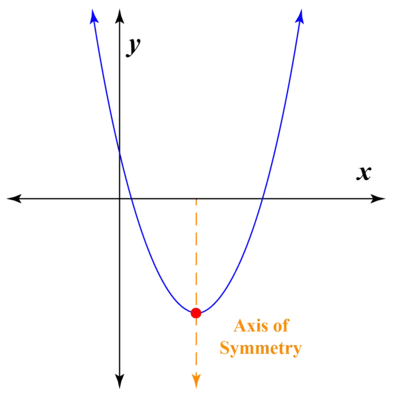
For a quadratic function in standard form:
$$ f(x) = ax^2 + bx + c $$
$$ x = -\frac{b}{2a} $$
Find the axis of symmetry of \(y = (x + 5)^2 - 4\).
Step 1: Expand the quadratic
\(f(x) = (x + 5)^2 - 4 = x^2 + 10x + 21\)
Step 2: Identify coefficients
\(a = 1, b = 10\)
Step 3: Apply the formula
\(x = -\frac{b}{2a} = -\frac{10}{2 \cdot 1} = -5\)
Result: Axis of symmetry = \((-5, 0)\)
If the roots of a quadratic equation are known, the axis of symmetry can be found as the midpoint of the roots.
$$ x = \frac{r_1 + r_2}{2} $$
If the roots of a quadratic function are \(3\) and \(7\), find the axis of symmetry.
\(x = \frac{3 + 7}{2} = \frac{10}{2} = 5\)
Result: Axis of symmetry = \((5, 0)\)
Related
Add this calculator to your site.
×Just copy a given code & paste it right now into your website HTML (source) for suitable page.
Preview:



Easter into Action, Save With Satisfaction
UPTO
50 %
OFF
Give Us Your Feedback
Share Result
Axis of Symmetry Calculator

Links
Home Conversion Calculator About Calculator Online Blog Hire Us Knowledge Base Sitemap Sitemap TwoEmail us at
Contact Us© Copyrights 2026 by Calculator-Online.net
