
 AI Tools
 Health
 Math
Math Everyday Life
 Finance
 Physics
 Chemistry
 Statistics
 Construction
 Pets
Pets Time & Date
 Conversion Calculator
 Sign In
Pages
Category
Follow Us On:
Pages
Category
Follow Us On:
Enter the function, then click “Calculate” to instantly get the domain, range, and graph of the function.
Related
This domain and range calculator helps you find all possible input (domain) and output (range) values for any function. Results are shown in interval notation and include a graph to visualize where the function is defined and what values it can produce.
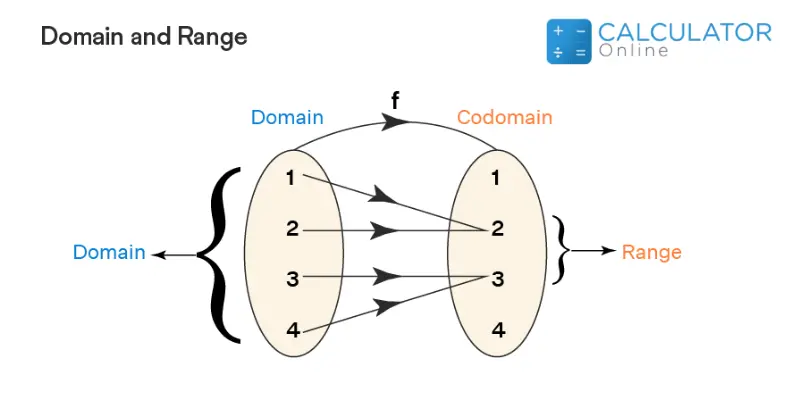
The domain and range describe all valid inputs and outputs of a function, giving insight into its behavior.
The set of all possible input values (x-values) for a function. It defines the values of x for which the function is valid. Learn more about functions.
The set of all possible output values (y-values) that the function produces when evaluated over its domain.
Input your function f(x) in the calculator field.
The calculator processes the function and provides the domain and range.
y = (x + 3) / (10 - x)
Domain:
Denominator cannot be zero: 10 - x ≠ 0 → x ≠ 10
✅ Domain: x ∈ (-∞, 10) ∪ (10, ∞)
Range:
y = (x + 3) / (10 - x)
Solving for x: y(10 - x) = x + 3 → x = (10y - 3)/(-y - 1)
Denominator cannot be zero: -y - 1 ≠ 0 → y ≠ -1
✅ Range: y ∈ (-∞, -1) ∪ (-1, ∞)
The domain shows all valid x-values. Example: x ∈ (-∞, 10) ∪ (10, ∞) excludes x = 10.
The range shows all possible outputs. Example: y ∈ (-∞, -1) ∪ (-1, ∞) excludes y = -1.
Yes, if the function maps a set onto itself (e.g., f(x) = x):
A constant function always outputs the same value for all inputs. Example: f(x) = c.
Related
Add this calculator to your site.
×Just copy a given code & paste it right now into your website HTML (source) for suitable page.
Preview:



Easter into Action, Save With Satisfaction
UPTO
50 %
OFF
Give Us Your Feedback
Share Result
Domain and Range Calculator

Links
Home Conversion Calculator About Calculator Online Blog Hire Us Knowledge Base Sitemap Sitemap TwoEmail us at
Contact Us© Copyrights 2026 by Calculator-Online.net
