
 AI Tools
 Health
 Math
Math Everyday Life
 Finance
 Physics
 Chemistry
 Statistics
 Construction
 Pets
Pets Time & Date
 Conversion Calculator
 Sign In
Pages
Category
Follow Us On:
Pages
Category
Follow Us On:
The free e calculator will quickly compute the value of e raised to a certain power of x, with the steps displayed.
Related
The e calculator helps you compute the value of e to the power of x, denoted as \(e^x\). It also supports other exponential functions like \(10^x\) or \(a^x\). Enter any number or power, and the calculator quickly provides the result along with a simple step-by-step solution.
In mathematics, e is a fundamental constant. It is an irrational number, meaning it cannot be expressed as a fraction and has an infinite decimal expansion. It is also called Euler’s number or the natural number.
e ≈ 2.718281828459045…
Because e has an infinite decimal expansion, rounding is often used in calculations. It is the base of natural logarithms and appears in natural exponential functions:
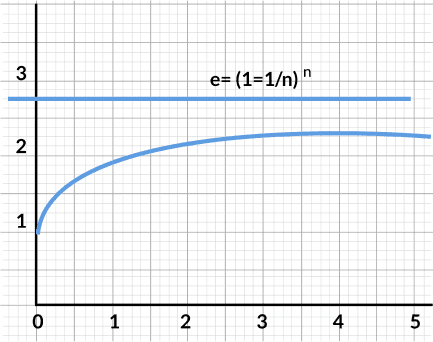
Mathematically, e can be expressed as the limit:
$$ e = \lim_{n \to \infty} \left(1 + \frac{1}{n}\right)^n $$
It can also be calculated as an infinite series:
$$ e = 1 + \frac{1}{1!} + \frac{1}{2!} + \frac{1}{3!} + \dots $$
On calculators, e often represents scientific notation. For example, 5e13 means \(5 \times 10^{13}\). Here, 13 is the exponent and 5 is the coefficient. This notation is used for handling very large or very small numbers efficiently.
Methods to calculate \(e^x\) include:
Example (approximating e using the first 5 terms of the series for x=1):
1 + 1 + 1/2 + 1/6 + 1/24 ≈ 2.71666
The function \(e^x\) grows exponentially. The slope of the tangent at any point equals the y-coordinate at that point.
| ex | Value |
|---|---|
| e1 | 2.71828 |
| e2 | 7.38906 |
| e3 | 20.08554 |
| e4 | 54.59815 |
| e5 | 148.41316 |
| e6 | 403.42879 |
| e7 | 1096.63316 |
The calculator allows unlimited free calculations for practice and learning.
Raising e to infinity gives infinity: \(e^\infty = \infty\). For finite numbers, e behaves normally, e.g., \(e^1 ≈ 2.71828\).
Leonhard Euler discovered e and calculated its value to 23 decimal places. It is called “natural” because it is the base of natural logarithms.
No. \(e^x\) is always positive and never equals zero.
No. π is a geometric constant, while e arises from limits, logarithms, and exponential functions. They are mathematically distinct.
Calculating \(e^x\) manually is difficult due to its infinite nature. This free e calculator allows quick and accurate computation for learning, homework, or practical applications.
Related
Add this calculator to your site.
×Just copy a given code & paste it right now into your website HTML (source) for suitable page.
Preview:



Easter into Action, Save With Satisfaction
UPTO
50 %
OFF
Give Us Your Feedback
Share Result
e Calculator

Links
Home Conversion Calculator About Calculator Online Blog Hire Us Knowledge Base Sitemap Sitemap TwoEmail us at
Contact Us© Copyrights 2026 by Calculator-Online.net
