
 AI Tools
 Health
 Math
Math Everyday Life
 Finance
 Physics
 Chemistry
 Statistics
 Construction
 Pets
Pets Time & Date
 Conversion Calculator
 Sign In
Pages
Category
Follow Us On:
Pages
Category
Follow Us On:
Enter the values into this enthalpy change calculator to determine the enthalpy change using either the formula or a chemical reaction scheme instantly.
Related
Our enthalpy calculator helps you determine the enthalpy change (ΔH) of chemical reactions, including initial and final enthalpy values, using Hess's Law, standard enthalpies of formation, or energy data. This tool is ideal for analyzing heat exchange and energy changes in thermodynamic systems.
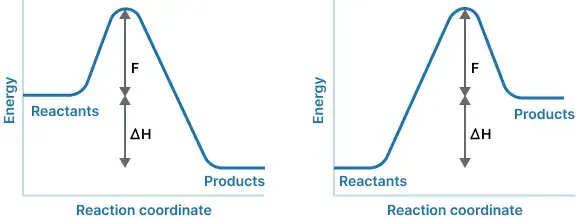
Enthalpy is a measure of the total heat content of a system. It combines the system's internal energy with the energy required to displace its surroundings (pressure-volume work).
During phase changes, such as melting or boiling, a system absorbs or releases energy. This absorbed or released energy is a specific example of enthalpy change: the latent heat of fusion or vaporization.
Enthalpy Formula: H = U + PV
Where:
Enthalpy is measured in joules (J) or kilojoules (kJ). Since absolute enthalpy is difficult to measure, we focus on enthalpy change (ΔH), which indicates the heat absorbed or released during a reaction:
ΔH = ΔU + P × ΔV
Where:
aA + bB → cC + dD
Standard enthalpy of reaction can be calculated as:
ΔH° = ∑ΔH°f(products) - ∑ΔH°f(reactants)
Where:
Consider a reaction at 100 Pa. The reactants have an internal energy of 120 J and a volume of 50 m3, while the products have an internal energy of 80 J and a volume of 70 m3. Calculate initial enthalpy, final enthalpy, and ΔH.
Given:
ΔU = Uproducts - Ureactants = 80 - 120 = -40 J
ΔV = Vproducts - Vreactants = 70 - 50 = 20 m3
P ΔV = 100 Pa × 20 m3 = 2000 J
ΔH = ΔU + P ΔV = -40 + 2000 = 1960 J (Endothermic)
Hinitial = Ureactants + P × Vreactants = 120 + 100 × 50 = 5120 J
Hfinal = Uproducts + P × Vproducts = 80 + 100 × 70 = 7080 J
Summary:
Use the enthalpy calculator for faster step-by-step results.
| No. | Substance | Formula | ΔH°f (kJ/mol) |
| 1 | Methane | CH4(g) | -74.8 |
| 2 | Ethane | C2H6(g) | -84.7 |
| 3 | Carbon Monoxide | CO(g) | -110.5 |
| 4 | Carbon Dioxide | CO2(g) | -393.5 |
| 5 | Water | H2O(l) | -285.8 |
| 6 | Ammonia | NH3(g) | -46.0 |
| 7 | Hydrogen Chloride | HCl(g) | -92.3 |
| 8 | Sulfur Dioxide | SO2(g) | -296.1 |
| 9 | Phosphorus Pentachloride | PCl5(g) | -398.9 |
| 10 | Phosphorus Trichloride | PCl3(g) | -306.4 |
Hess’s Law states that the total enthalpy change of a reaction is the same, regardless of whether it occurs in one step or multiple steps.
Yes, liquids typically have higher enthalpy than solids because particles in liquids move more freely and have weaker intermolecular forces.
Yes, though the calculation is more complex due to interactions among different substances affecting the total enthalpy.
Source: Enthalpy - Wikipedia
Related
Add this calculator to your site.
×Just copy a given code & paste it right now into your website HTML (source) for suitable page.
Preview:



Easter into Action, Save With Satisfaction
UPTO
50 %
OFF
Give Us Your Feedback
Share Result
Enthalpy Calculator

Links
Home Conversion Calculator About Calculator Online Blog Hire Us Knowledge Base Sitemap Sitemap TwoEmail us at
Contact Us© Copyrights 2026 by Calculator-Online.net
