
 AI Tools
 Health
 Math
Math Everyday Life
 Finance
 Physics
 Chemistry
 Statistics
 Construction
 Pets
Pets Time & Date
 Conversion Calculator
 Sign In
Pages
Category
Follow Us On:
Pages
Category
Follow Us On:
Choose the inequality type and enter your expression (e.g., x + 1 > 3). The calculator will provide a step-by-step solution and a visual number line representation of the solution.
Related
Our inequality calculator allows you to solve linear, quadratic, and rational inequalities quickly and accurately. It provides step-by-step solutions and graphical representations, making complex inequalities easy to understand and visualize.
An inequality is a statement that compares two expressions using symbols like greater than, less than, greater than or equal to, or less than or equal to.
Examples:
3 + 5 < 10, 2y - 4 > 6
Understanding these symbols is essential for solving inequalities:
The symbols > and < indicate strict inequalities, while >= and <= allow equality as well.
These rules are applied automatically by our calculator for linear, quadratic, and rational inequalities.
Multiplying both sides by a negative number reverses the inequality.
If a > b and c < 0, then a·c < b·c
Multiplying both sides by a positive number preserves the inequality.
If a > b and c > 0, then a·c > b·c
Dividing both sides by a negative number reverses the inequality.
If a > b and c < 0, then a/c < b/c
Dividing both sides by a positive number preserves the inequality.
If a > b and c > 0, then a/c > b/c
Adding the same number to both sides does not change the inequality.
If a > b and c ∈ R, then a + c > b + c
Subtracting the same number from both sides does not change the inequality.
If a > b and c ∈ R, then a - c > b - c
Squaring both sides with positive numbers preserves the inequality.
Squaring both sides with negative numbers reverses the inequality.
Taking the reciprocal of non-zero values reverses the inequality.
For example, to solve 5x > 10, divide both sides by 5 to get x > 2. A linear inequality calculator can also provide a graph of the solution.
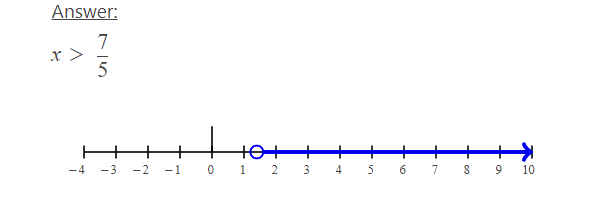
Quadratic inequalities like x2 + 5x + 6 < 0 are solved by finding the roots and analyzing the intervals. A quadratic inequality calculator provides step-by-step solutions and graphs. Here, the roots are x = -2 and x = -3, and the inequality holds between the roots.

Rational inequalities like (x + 2)/(x - 1) > 3 are solved using critical points and test intervals. A rational inequality calculator also provides graphical representation for clarity.
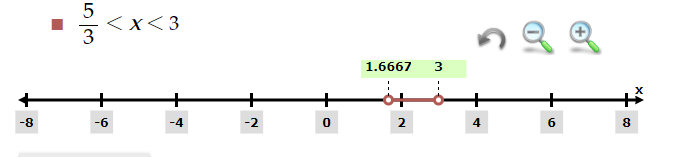
Using the calculator is straightforward:
Input:
Output:
References:
Wikipedia: Inequality (Mathematics)
BBC Bitesize: Inequalities
TutorMe: Introduction to Inequalities
Related
Add this calculator to your site.
×Just copy a given code & paste it right now into your website HTML (source) for suitable page.
Preview:



Easter into Action, Save With Satisfaction
UPTO
50 %
OFF
Give Us Your Feedback
Share Result
Inequality Calculator

Links
Home Conversion Calculator About Calculator Online Blog Hire Us Knowledge Base Sitemap Sitemap TwoEmail us at
Contact Us© Copyrights 2026 by Calculator-Online.net
