
 AI Tools
 Health
 Math
Math Everyday Life
 Finance
 Physics
 Chemistry
 Statistics
 Construction
 Pets
Pets Time & Date
 Conversion Calculator
 Sign In
Pages
Category
Follow Us On:
Pages
Category
Follow Us On:
Write down the binomial series, and the Pascal's triangle calculator will determine the binomial expansion using Pascal's triangle formula, with detailed steps shown.
Related
The Pascal’s Triangle Calculator generates entries for a specific row in a binomial expansion. It helps you find coefficients easily, making it simple to understand the binomial theorem and its expansion.
Named after Blaise Pascal, a French mathematician, Pascal’s triangle arranges numbers in rows where each number is calculated based on its row n and column k.
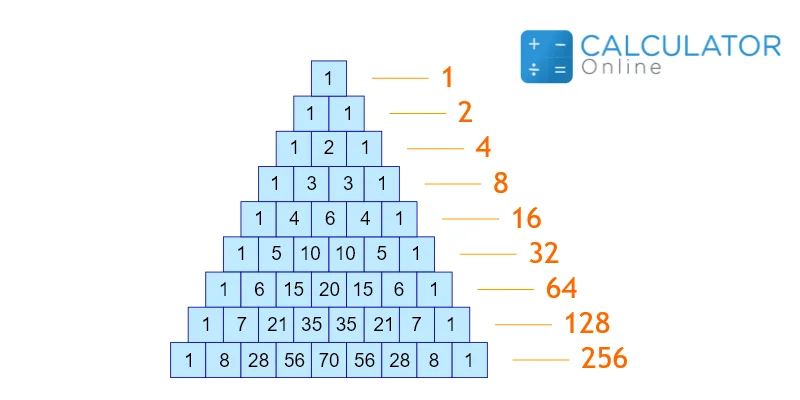
It provides an easy way to find coefficients in binomial expansions.
The number in the nth row and kth column is calculated using the binomial coefficient:
$$ a_{n,k} = \frac{n!}{k!(n-k)!} = \binom{n}{k} $$
The calculator uses this formula to compute coefficients for any binomial expansion.
Expand (a + b)^4 using Pascal’s triangle.
Row 4 coefficients: 1, 4, 6, 4, 1
(a + b)^4 = 1·a^? + 4·a^?b^? + 6·a^?b^? + 4·a^?b^? + 1·b^4
Final expansion:
(a + b)^4 = a^4 + 4a^3b + 6a^2b^2 + 4ab^3 + b^4
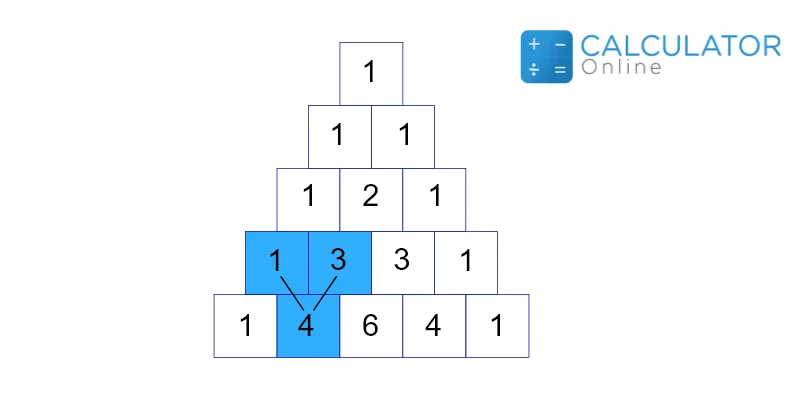
Each number is the sum of the two numbers directly above it:
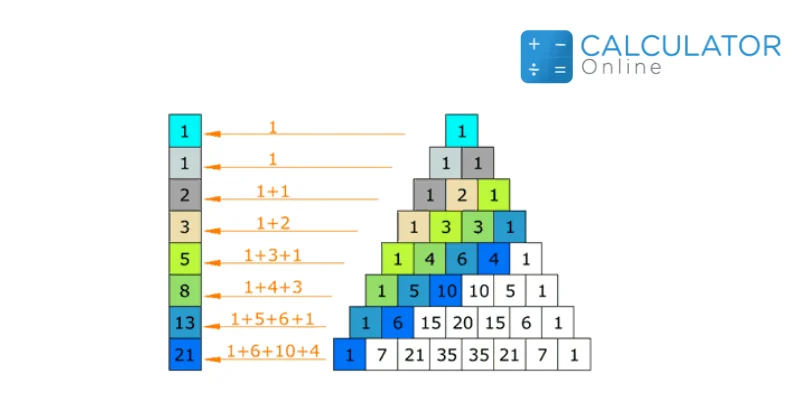
Diagonal sums of Pascal’s triangle produce Fibonacci numbers:
| Row | Coefficients |
|---|---|
| 8th row | 1, 8, 28, 56, 70, 56, 28, 8, 1 |
| 9th row | 1, 9, 36, 84, 126, 126, 84, 36, 9, 1 |
| 10th row | 1, 10, 45, 120, 210, 252, 210, 120, 45, 10, 1 |
| 11th row | 1, 11, 55, 165, 330, 462, 462, 330, 165, 55, 11, 1 |
| 13th row | 1, 13, 78, 286, 715, 1287, 1716, 1716, 1287, 715, 286, 78, 13, 1 |
| 15th row | 1, 15, 105, 455, 1365, 3003, 5005, 6435, 6435, 5005, 3003, 1365, 455, 105, 15, 1 |
| 20th row | 1, 20, 190, 1140, 4845, 15504, 38760, 77520, 125970, 167960, 184756, 167960, 125970, 77520, 38760, 15504, 4845, 1140, 190, 20, 1 |
| 30th row | 1, 30, 435, 4060, 27405, 142506, 593775, 2035800, 5852925, 14307150, 30045015, 54627300, 86493225, 119759850, 145422675, 155117520, 145422675, 119759850, 86493225, 54627300, 30045015, 14307150, 5852925, 2035800, 593775, 142506, 27405, 4060, 435, 30, 1 |
The output will display the selected row, its coefficients, and a visual representation of the triangle.
Yes. Each row is symmetrical; numbers on the left mirror numbers on the right.
The sum of numbers in the nth row equals 2^n. Example: Row 0 → 1, Row 1 → 1+1=2, Row 2 → 1+2+1=4, and so on.
The Pascal’s Triangle Calculator makes it easy to find coefficients for binomial expansions, understand Fibonacci sequences, and solve combinatorial problems.
Related
Add this calculator to your site.
×Just copy a given code & paste it right now into your website HTML (source) for suitable page.
Preview:



Easter into Action, Save With Satisfaction
UPTO
50 %
OFF
Give Us Your Feedback
Share Result
Pascal's Triangle Calculator

Links
Home Conversion Calculator About Calculator Online Blog Hire Us Knowledge Base Sitemap Sitemap TwoEmail us at
Contact Us© Copyrights 2026 by Calculator-Online.net
