
 AI Tools
 Health
 Math
Math Everyday Life
 Finance
 Physics
 Chemistry
 Statistics
 Construction
 Pets
Pets Time & Date
 Conversion Calculator
 Sign In
Pages
Category
Follow Us On:
Pages
Category
Follow Us On:
Select the parameter and provide all the required ones. The calculator will take instants to calculate the potential energy, acceleration, mass, and height of the object.
Related
Our Potential Energy Calculator allows you to calculate the mass, acceleration due to gravity, height, or gravitational potential energy of an object quickly and accurately.
In physics, potential energy is the energy stored in an object due to its position, configuration, or state.
Definition:
"The energy required to move an object against the force of gravity is called gravitational potential energy."
The higher an object is lifted above a reference point, the greater its gravitational potential energy. As the object moves closer to the ground, its potential energy decreases.
Real-life examples of potential energy:
The gravitational potential energy (P.E.) of an object is calculated using:
P.E = m × g × h
Where:
When an object falls freely toward Earth, it accelerates due to gravity. Near the Earth's surface, this acceleration has an approximate value of:
g = 9.8 m/s2
This value may vary slightly depending on altitude and location.
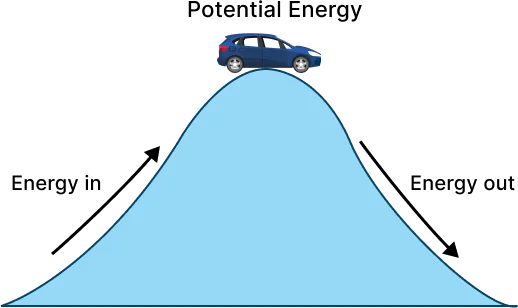
In the image above, a car climbs a cliff. At the bottom, the car has maximum kinetic energy and minimal potential energy. As it ascends, its height increases, causing gravitational potential energy to increase while kinetic energy decreases.
At the highest point, the car momentarily comes to rest. Here, gravitational potential energy is maximum and kinetic energy is zero. As the car descends, potential energy converts back into kinetic energy due to the conservation of mechanical energy.
Let’s understand the calculation process with examples:
Find the potential energy of an object with:
Solution:
P.E = m × g × h
P.E = 96.2 × 9.8 × 10
P.E = 9427.6 J
The gravitational potential energy is 9427.6 joules.
An object has:
Find the height (h).
Solution:
Rearranging the formula:
h = P.E / (m × g)
h = 63 / (25 × 4.2)
h = 0.6 m
The height of the object is 0.6 meters.
An object has:
Find its mass.
Solution:
Rearranging the formula:
m = P.E / (g × h)
m = 7.8 / (9.8 × 4.1)
m ≈ 0.194 kg
The mass of the object is approximately 0.194 kilograms.
Our free gravitational potential energy calculator helps you determine any missing variable in the equation P.E = m × g × h.
Select the unknown parameter you want to calculate:
Enter the known values and click Calculate.
From Wikipedia: Work and potential energy, gravitational potential energy, negative gravitational energy.
From Khan Academy: Conservation of energy and work-energy principles.
Related
Add this calculator to your site.
×Just copy a given code & paste it right now into your website HTML (source) for suitable page.
Preview:



Easter into Action, Save With Satisfaction
UPTO
50 %
OFF
Give Us Your Feedback
Share Result
Potential Energy Calculator

Links
Home Conversion Calculator About Calculator Online Blog Hire Us Knowledge Base Sitemap Sitemap TwoEmail us at
Contact Us© Copyrights 2026 by Calculator-Online.net
