
 AI Tools
 Health
 Math
Math Everyday Life
 Finance
 Physics
 Chemistry
 Statistics
 Construction
 Pets
Pets Time & Date
 Conversion Calculator
 Sign In
Pages
Category
Follow Us On:
Pages
Category
Follow Us On:
Enter the length and width of the grid and the calculator will calculate the number of rebars, rebar length, and cost required to build up the rebar grid.
Related
The online Concrete Rebar Calculator helps civil engineers estimate the amount of Rebar needed for a concrete slab. It also assists in determining the optimal grid layout for proper reinforcement.
In this guide, we explain how to calculate Rebar for your project to ensure your structures remain safe and durable.
Rebar’s ability to expand and contract along with concrete makes it a crucial component for reinforcing slabs. This property significantly improves the strength and durability of concrete slab footings. Proper Rebar calculations are essential when placing steel in concrete, and a Rebar slab calculator can quickly provide accurate quantities.
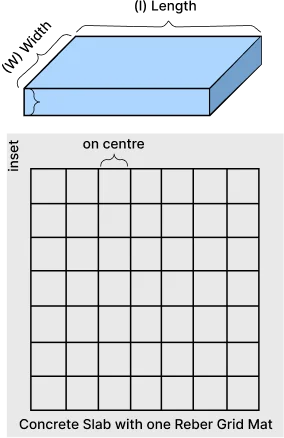
Using a Rebar calculator allows you to determine the required Rebar for a slab efficiently and accurately.
Rebar is available in both Imperial and Metric sizes. With a concrete slab Rebar calculator, you can quickly calculate the required amount. Below is a table showing the nominal diameters for common Rebar sizes:
| Imperial bar size | Nominal diameter (in) | Metric bar size | Nominal diameter (mm) |
| #2 | 0.250 = 1/4 | No.6 | 6.35 |
| #3 | 0.375 = 3/8 | No.10 | 9.525 |
| #4 | 0.500 = 1/2 | No.13 | 12.7 |
| #5 | 0.625 = 5/8 | No.16 | 15.875 |
| #6 | 0.750 = 3/4 | No.19 | 19.05 |
| #7 | 0.875 = 7/8 | No.22 | 22.225 |
| #8 | 1.000 = 8/8 | No.25 | 25.4 |
| #9 | 1.128 ≈ 9/8 | No.29 | 28.65 |
| #10 | 1.270 ≈ 10/8 | No.32 | 32.26 |
| #11 | 1.410 ≈ 11/8 | No.36 | 35.81 |
| #14 | 1.693 ≈ 14/8 | No.43 | 43 |
| #18 | 2.257 ≈ 18/8 | No.57 | 57.3 |
Accurate Rebar measurement is essential, and a Rebar weight calculator can simplify this process.
Manual calculations are not necessary. A concrete slab Rebar calculator can instantly compute the Rebar needed. To understand the method, you should know the following terms:
Calculating Rebar requires knowing the slab dimensions, especially length and width. The Rebar grid length formula is:
Grid length = Slab length - (2 × Edge Rebar Spacing)
The total Rebar length is calculated both vertically and horizontally. A Rebar spacing calculator can help determine the quantity needed precisely.
The number of Rebar rows is found by dividing the grid length by the Rebar spacing. You can also use a Rebar weight calculator to determine the total weight.
Total Rebars Length = (Rebar Columns × Rebar Length) + (Rebar Rows × Rebar Width)
Divide the total Rebar length by the length of a single Rebar piece to find the number of pieces required.
Rebar Pieces = Total Rebars Length / Single Rebar Length
Multiply the total number of Rebar pieces by the unit price to calculate the total cost.
Total Rebar Cost = Total Pieces × Unit Price
The cost depends on slab dimensions, Rebar spacing, and the price per unit. A Rebar cost calculator quickly estimates total expenses.
If the total Rebar length is 840 feet, each piece is 20 feet, and the price per piece is $5.63, the total cost is:
Total Rebar Cost = 840 × (5.63 / 20) Total Rebar Cost = $236.46
The calculator provides accurate Rebar requirements for slabs.
Input:
Output:
Determine the Rebar needed per footing. A common rule is 1 Rebar per 8 inches of footing width. For example, a 16-inch footing needs 2 Rebars. An online Rebar calculator can speed up this estimation.
Rebar spacing can be checked using charts or manufacturer guidelines. Typically, spacing is 12 inches. For exact spacing, use a slab Rebar calculator.
Use Rebar approximately 1/8 of slab thickness. A Rebar calculator ensures the correct size.
Yes, gravel stabilizes the foundation, improves drainage, and prevents water pooling.
#3 Rebar has 6,600 lbs yield strength, while #4 has 11,780 lbs. #4 is roughly 78% stronger. Use a calculator to verify requirements.
Rebar strengthens concrete slabs and extends their lifespan. Steel mesh improves adhesion and structural integrity, providing long-lasting durability.
From Wikipedia: Rebar, Use in concrete and masonry
From Wikipedia: Stainless Steel Reinforcement, Advantages of stainless steel reinforcement
Related
Add this calculator to your site.
×Just copy a given code & paste it right now into your website HTML (source) for suitable page.
Preview:



Easter into Action, Save With Satisfaction
UPTO
50 %
OFF
Give Us Your Feedback
Share Result
Rebar Calculator

Links
Home Conversion Calculator About Calculator Online Blog Hire Us Knowledge Base Sitemap Sitemap TwoEmail us at
Contact Us© Copyrights 2026 by Calculator-Online.net
