
 AI Tools
 Health
 Math
Math Everyday Life
 Finance
 Physics
 Chemistry
 Statistics
 Construction
 Pets
Pets Time & Date
 Conversion Calculator
 Sign In
Pages
Category
Follow Us On:
Pages
Category
Follow Us On:
Enter your function and limits to perform the integration using the shell method step-by-step.
Related
Our shell method calculator helps you find the volume of solids of revolution using cylindrical shells. It shows step-by-step integration so you can understand each part of the calculation easily.
The shell method is a technique in calculus used to compute volumes by wrapping thin cylindrical shells around an axis of rotation. It's especially useful when the axis of rotation is parallel to the axis along which the function is defined, making other methods more complicated.
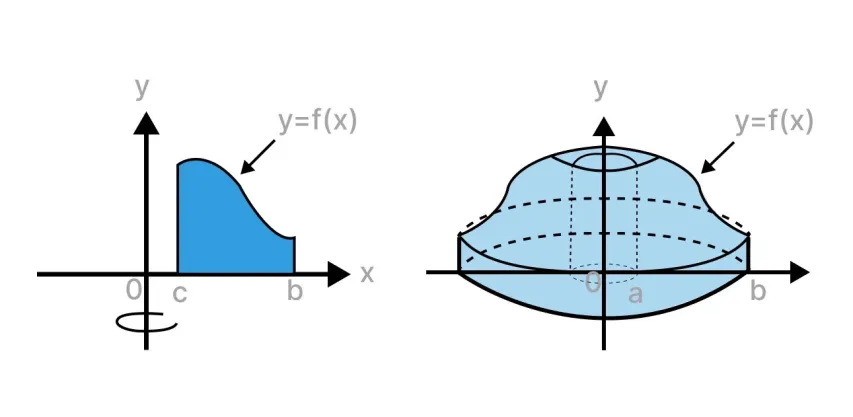
The formula depends on the axis around which the region is rotated:
V = ∫ab 2π r(x) h(x) dx (rotation about vertical axis)
V = ∫cd 2π r(y) h(y) dy (rotation about horizontal axis)
For a region defined by y = f(x) over [a, b]:
For a region defined by x = f(y) over [c, d]:
These formulas allow our calculator to provide accurate volumes for all types of rotations.
Find the volume of the solid formed when the area under f(x) = x² + 1 from x = 1 to x = 2 is rotated around the y-axis.
Step 1: Apply the shell formula
V = 2π∫12 x (x² + 1) dx = 2π∫12 (x³ + x) dx
Step 2: Integrate each term
∫ x³ dx = x⁴ / 4, ∫ x dx = x² / 2
Step 3: Multiply by 2π
V = 2π ((x⁴ / 4) + (x² / 2))
Step 4: Evaluate from x = 1 to x = 2
V = 2π ((16/4 + 4/2) - (1/4 + 1/2)) = 2π (4 + 2 - 0.25 - 0.5) = 11.5π ≈ 36.128 (units³)
Yes. The shell method works for vertical, horizontal, or offset axes as long as you correctly define the shell's radius and height.
Related
Add this calculator to your site.
×Just copy a given code & paste it right now into your website HTML (source) for suitable page.
Preview:



Easter into Action, Save With Satisfaction
UPTO
50 %
OFF
Give Us Your Feedback
Share Result
Shell Method Calculator

Links
Home Conversion Calculator About Calculator Online Blog Hire Us Knowledge Base Sitemap Sitemap TwoEmail us at
Contact Us© Copyrights 2026 by Calculator-Online.net
