
 AI Tools
 Health
 Math
Math Everyday Life
 Finance
 Physics
 Chemistry
 Statistics
 Construction
 Pets
Pets Time & Date
 Conversion Calculator
 Sign In
Pages
Category
Follow Us On:
Pages
Category
Follow Us On:
Enter the function, limits, and number of rectangles into the trapezoidal rule calculator to estimate the area under the graph using the trapezoidal approximation method, with detailed calculations shown.
Related
The online trapezoidal rule calculator helps approximate the area under a curve for any given mathematical function using the trapezoidal integration method. This free tool splits the interval into smaller subintervals and computes results with detailed step-by-step calculations for better accuracy. Let’s understand the trapezoidal rule and its summation formula.
In numerical analysis, the trapezoidal rule is a method used to approximate the value of definite integrals when an exact solution is difficult to compute.
∫^x_y f(y) dy
This technique estimates the area beneath a curve f(y) by dividing it into trapezoid-shaped sections and calculating their combined area:
∫^x_y f(j) dj ≈ (x – y) * (f(x) + f(y)) / 2
The trapezoidal rule calculator uses this trapezium-based approximation formula to evaluate definite integrals quickly.
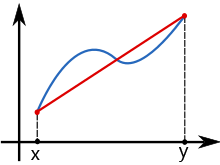
For more advanced integral evaluations, you may also use the Online Integral Calculator to compute exact antiderivatives and definite integrals.
(Image)
The area of a trapezoid is calculated using the formula:
Area = h/2 * (a + b)
Where:
h = perpendicular height between the two parallel sides
Follow the procedure below to approximate integrals manually using the trapezoidal approach.
$$\int^y_x f(a)da ≈ Δa/2 [f(a^0) + 2f(a^1) + ... + 2f(a^{n-1}) + f(a^n)], \text{where } Δa = (y-x)/n.$$
You can also try the Riemann Sum Calculator to approximate integrals using midpoint, left, right, or trapezoidal sampling methods.
Example:
Approximate the integral using the trapezoidal rule where n = 5:
$$\int^{0}_{1} \sqrt{1 + \sin 3y} \, dy$$
Solution:
Let f(a) = √(1 + sin 3a), x = 0, y = 1, n = 5.
Using the trapezoidal step size:
$$Δa = (y-x)/n = (1-0)/5 = 1/5$$
Divide the interval [0,1] into five equal parts:
0, 1/5, 2/5, 3/5, 4/5, 1
Evaluate function values:
f(0) = √(1 + sin3(0)) = 1
2f(1/5) = 2√(1 + sin3(1/5)) = 2.0078
2f(2/5) = 2√(1 + sin3(2/5)) = 2.0582
2f(3/5) = 2√(1 + sin3(3/5)) = 2.1725
2f(4/5) = 2√(1 + sin3(4/5)) = 2.3402
f(1) = √(1 + sin3(1)) = 1.2632
Multiply the total by Δa/2 = 1/10:
$$\text{Approximate integral} = 1/10 (1 + 2.0078 + 2.0582 + 2.1725 + 2.3402 + 1.2632) = 1.0842$$
No. Simpson’s rule uses parabolic arcs to approximate curves, whereas the trapezoidal rule uses straight-line segments.
Simpson’s rule generally produces more accurate results for smooth or quadratic functions. However, the trapezoidal rule is simpler and effective for quick approximations.
This trapezoidal rule calculator is a reliable tool for estimating definite integrals quickly. It is ideal for students, educators, and professionals who need fast numerical integration with step-by-step explanations.
Wikipedia: Trapezoidal Rule, numerical integration techniques.
Math24: Trapezoidal Rule, definite integral approximation.
LibreTexts: Numerical Integration Methods.
Related
Add this calculator to your site.
×Just copy a given code & paste it right now into your website HTML (source) for suitable page.
Preview:



Easter into Action, Save With Satisfaction
UPTO
50 %
OFF
Give Us Your Feedback
Share Result
Trapezoidal Rule Calculator

Links
Home Conversion Calculator About Calculator Online Blog Hire Us Knowledge Base Sitemap Sitemap TwoEmail us at
Contact Us© Copyrights 2026 by Calculator-Online.net
