
 AI Tools
 Health
 Math
Math Everyday Life
 Finance
 Physics
 Chemistry
 Statistics
 Construction
 Pets
Pets Time & Date
 Conversion Calculator
 Sign In
Pages
Category
Follow Us On:
Pages
Category
Follow Us On:
Enter the atmospheric pressure, temperature, and relative humidity in the air density calculator to measure the air density of both dry and moist air.
Related
The air density calculator quickly computes the density of air in kg/m³ based on temperature and pressure conditions. Additionally, it can determine the dew point, air pressure, and water vapor pressure when the air is compressed.
Follow these steps to calculate air density:
Inputs:
Outputs: The calculator estimates the following:
The density of air can be calculated using this formula:
ρ = [(Pd / (Rd * T)) + (Pv / (Rv * T))]
Where:
For example, at a temperature of 15 °C and a pressure of 1013.25 hPa, air density is approximately 1.225 kg/m³. Air density, symbolized by ρ, represents the mass of air per unit volume.
To calculate air density, you need basic atmospheric parameters such as pressure, temperature, and humidity.
Air pressure is the force exerted by air molecules on a surface due to gravity. It is typically measured in Pascals using a barometer.
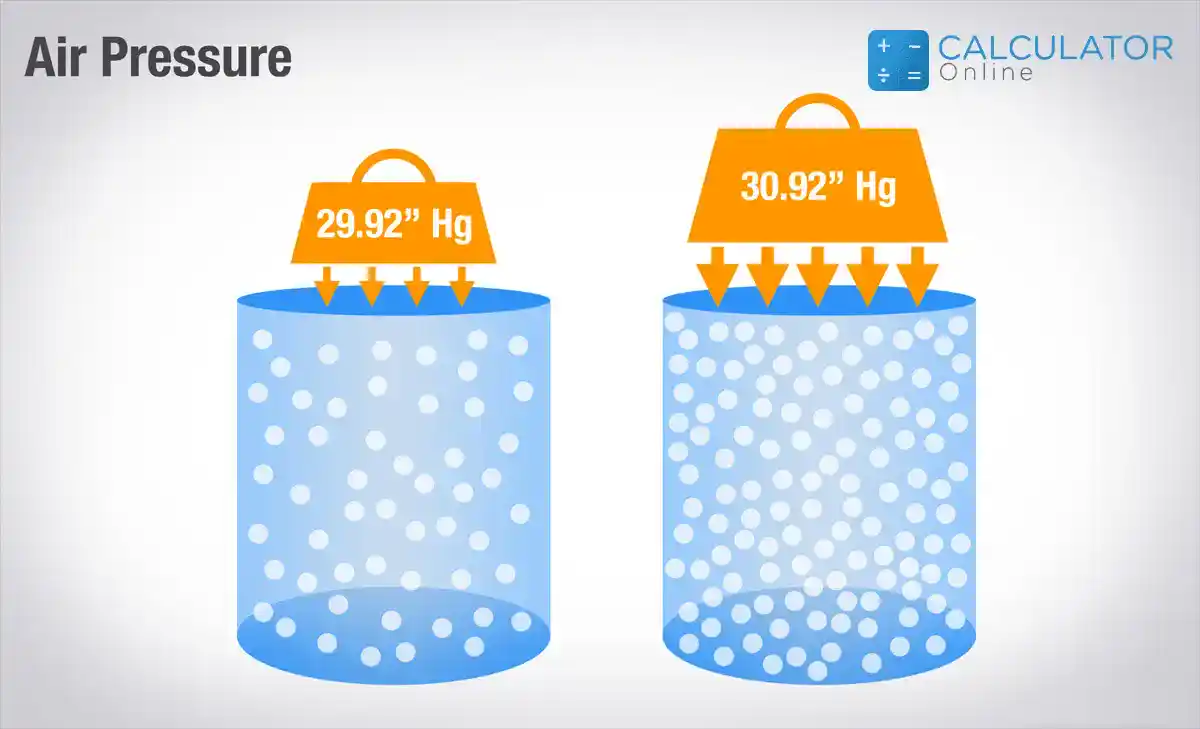
Common units of pressure include:
Temperature can be measured in Kelvin (K), Celsius (°C), or Fahrenheit (°F). Converting units may be necessary when calculating air density.
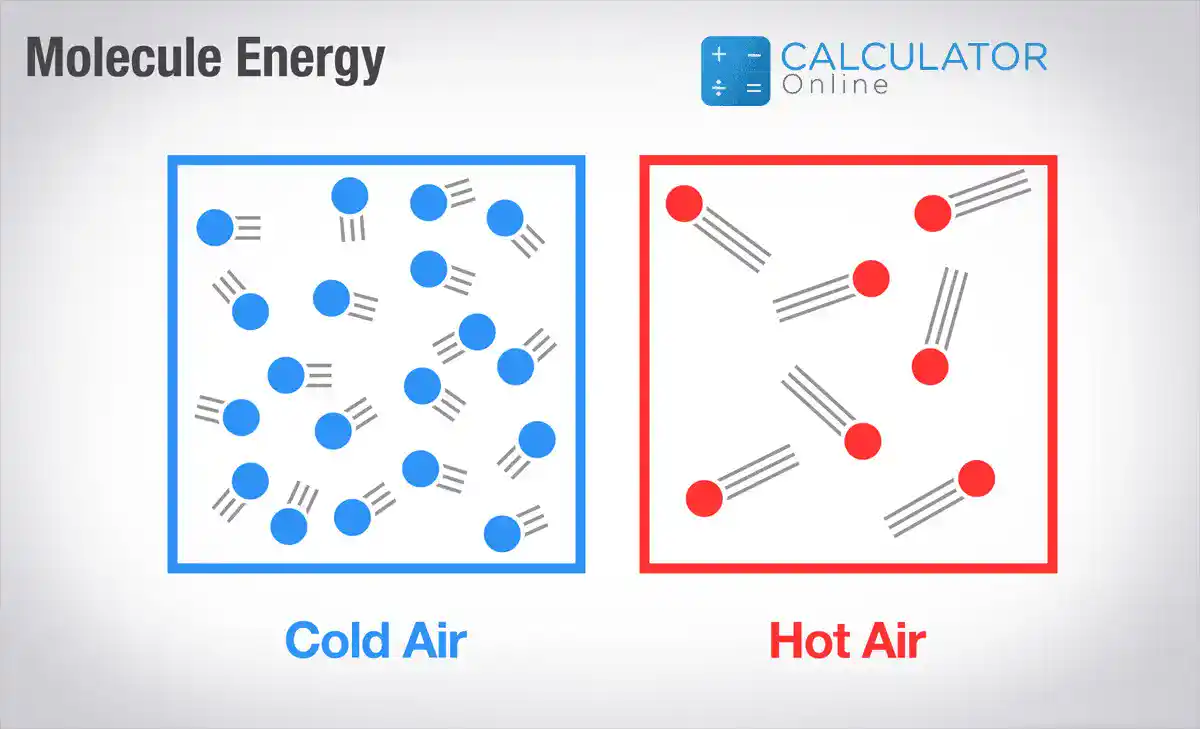
The dew point is the temperature at which water vapor condenses into liquid. You can calculate dew point manually or allow the calculator to compute it automatically based on other inputs.
The table below shows air density in lb/ft³ at 1 Pascal for different temperatures:
| Temperature | Pressure | Air Density (lb/ft³) |
|---|---|---|
| 15 °C | 1 Pa | 0.00000075474 |
| 20 °C | 1 Pa | 0.00000074187 |
| 22 °C | 1 Pa | 0.00000073684 |
| 25 °C | 1 Pa | 0.00000072943 |
| 40 °C | 1 Pa | 0.00000069449 |
Air density can also be expressed in lbm/ft³, sl/ft³ × 10⁻³, lbm/gal (US liquid), and kg/m³. The following table provides density, specific weight, and thermal expansion coefficients at different temperatures:
| Temperature (°F) | [lbm/ft³] | [sl/ft³×10⁻³] | [lbm/gal (US liq)] | [kg/m³] | [lbf/ft³] | [N/m³] | Thermal Expansion Coefficient (×10⁻³ °F⁻¹) |
|---|---|---|---|---|---|---|---|
| -100 | 0.1104 | 3.431 | 0.01476 | 1.768 | 0.1104 | 17.34 | 2.83 |
| -50 | 0.0968 | 3.010 | 0.01295 | 1.551 | 0.0968 | 15.21 | 2.48 |
| 0 | 0.0862 | 2.681 | 0.01153 | 1.382 | 0.0862 | 13.55 | 2.20 |
| 20 | 0.0826 | 2.569 | 0.01105 | 1.324 | 0.0826 | 12.98 | 2.10 |
| 40 | 0.0793 | 2.466 | 0.01061 | 1.271 | 0.0793 | 12.46 | 2.02 |
| 60 | 0.0763 | 2.372 | 0.01020 | 1.222 | 0.0763 | 11.99 | 1.94 |
| 100 | 0.0709 | 2.203 | 0.00948 | 1.135 | 0.0709 | 11.14 | 1.80 |
| 200 | 0.0602 | 1.870 | 0.00804 | 0.964 | 0.0602 | 9.45 | 1.53 |
| 300 | 0.0522 | 1.622 | 0.00698 | 0.836 | 0.0522 | 8.20 | 1.30 |
| 500 | 0.0410 | 1.274 | 0.00548 | 0.656 | 0.0410 | 6.43 | 1.05 |
| 700 | 0.0340 | 1.057 | 0.00455 | 0.545 | 0.0340 | 5.35 | 0.88 |
At sea level, air density is about 1.29 g/L or 0.07967 lb/ft³ at 0 °C. Standard sea-level pressure is 29.92 in Hg (760 mmHg).
At 25 °C and 100 kPa, the air density is roughly 1.168 kg/m³. The calculator can handle both dry and humid conditions.
Wikipedia: Density of Air
iFlyCoast: Understanding Air Density and Its Effects
Related
Add this calculator to your site.
×Just copy a given code & paste it right now into your website HTML (source) for suitable page.
Preview:



Easter into Action, Save With Satisfaction
UPTO
50 %
OFF
Give Us Your Feedback
Share Result
Air Density Calculator

Links
Home Conversion Calculator About Calculator Online Blog Hire Us Knowledge Base Sitemap Sitemap TwoEmail us at
Contact Us© Copyrights 2026 by Calculator-Online.net
