
 AI Tools
 Health
 Math
Math Everyday Life
 Finance
 Physics
 Chemistry
 Statistics
 Construction
 Pets
Pets Time & Date
 Conversion Calculator
 Sign In
Pages
Category
Follow Us On:
Pages
Category
Follow Us On:
Enter the value of tangential acceleration and radius, and the calculator will try to calculate the angular velocity.
Related
Use our angular acceleration calculator to quickly determine the angular acceleration of an object moving along a circular path. It also provides detailed calculations for tangential acceleration, helping you understand rotational motion thoroughly.
Angular acceleration describes the rate at which an object's angular velocity changes with time along a circular path. In simple terms:
Angular acceleration is the change in angular velocity per unit time.
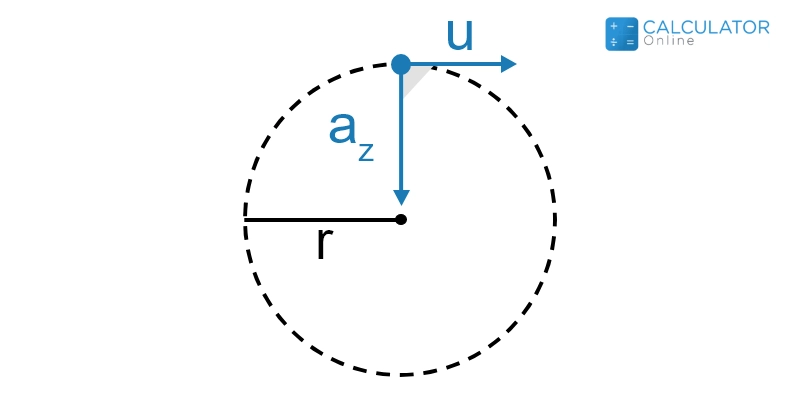
Our calculator can compute angular acceleration using either of these common formulas:
α = (ω₂ - ω₁) / t
or
α = a / R
Where:
The tangential acceleration calculator uses this same relationship to compute tangential velocity and acceleration efficiently.
Angular acceleration is commonly measured in radians per second squared (rad/s²) or degrees per second squared (°/s²). Sometimes it may appear in other forms such as 1/s² or Hz/s, depending on the context.
Let’s see an example to understand how angular acceleration is computed manually.
Example:
A car moves along a circular track with an initial angular velocity of 4 rad/s. After 70 seconds, its angular velocity increases to 78 rad/s. Calculate its angular acceleration.
Using the formula: α = (ω₂ - ω₁) / t
α = (78 - 4) / 70
α ≈ 1.05 rad/s²
Our calculator makes computing angular acceleration fast and accurate. Here’s how to use it:
Input:
Output:
Angular acceleration is directly proportional to the torque applied on a body. More torque produces greater angular acceleration. The calculator can help analyze this relationship for rotational systems.
Torque is the primary factor. Any force applied tangentially to a rotating object generates torque, which in turn changes the object’s angular velocity.
Angular acceleration can be constant if the torque applied is constant. Otherwise, it can vary over time depending on how the rotational force changes.
Angular acceleration is negative when the rotational speed decreases in the chosen positive direction. It can also be negative if the rotation is clockwise while the positive convention is counterclockwise.
No. Centripetal acceleration points toward the center of the circular path, while angular acceleration measures the rate of change of angular velocity along a fixed direction.
No. Angular velocity measures how fast an object rotates, while angular acceleration measures how quickly that rotation speed changes over time.
Understanding angular acceleration is essential for analyzing rotational motion, including vehicles, satellites, machinery, and projectiles. Our free angular acceleration calculator simplifies this process, allowing accurate computations of rotational motion parameters in seconds.
Wikipedia: Angular acceleration – concepts and torque relation.
Khan Academy: Angular Second Law – predicting rotational inertia and moment of inertia.
Lumen Learning: Rotational Kinematics – rotational motion equations and translational quantities.
Related
Add this calculator to your site.
×Just copy a given code & paste it right now into your website HTML (source) for suitable page.
Preview:



Easter into Action, Save With Satisfaction
UPTO
50 %
OFF
Give Us Your Feedback
Share Result
Angular Acceleration Calculator

Links
Home Conversion Calculator About Calculator Online Blog Hire Us Knowledge Base Sitemap Sitemap TwoEmail us at
Contact Us© Copyrights 2026 by Calculator-Online.net
