 AI Tools
 Health
 Math
Math Everyday Life
 Finance
 Physics
 Chemistry
 Statistics
 Construction
 Pets
Pets Time & Date
 Conversion Calculator
 Sign In
Pages
Category
Follow Us On:
Pages
Category
Follow Us On:
Write down the coordinates of the vector field and the tool will readily compute its divergence, showing detailed computations.
Related
Our online divergence calculator computes the divergence of a vector field, giving a scalar measure of how much the field spreads out or converges at a point. Like curl, divergence is widely used in physics, fluid dynamics, and engineering.
Definition: Divergence is a vector operator that measures the net "source" or "sink" at a point in a vector field. The result is a scalar value that indicates whether the field is expanding or compressing locally.
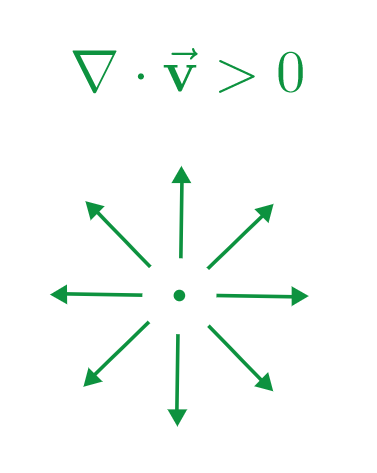
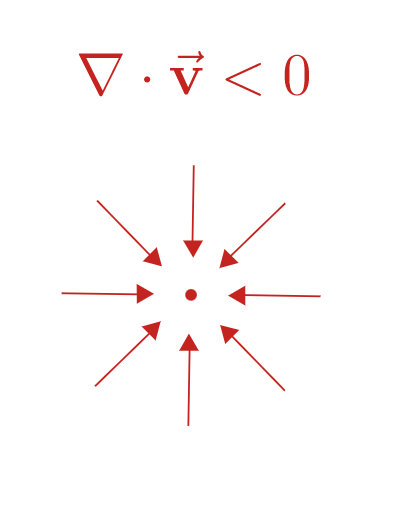
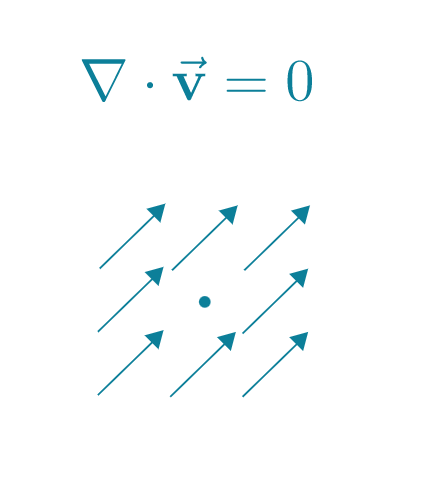
You can instantly evaluate each type using our free divergence calculator.
Mathematically, divergence is expressed as:
Divergence = ∇ · A
Where the del operator is defined as:
$$ \nabla = \left(\frac{\partial}{\partial x}, \frac{\partial}{\partial y}, \frac{\partial}{\partial z}\right) $$
For a vector field A = (P, Q, R), the divergence is:
$$ \text{Div} \, \vec{A} = \frac{\partial P}{\partial x} + \frac{\partial Q}{\partial y} + \frac{\partial R}{\partial z} $$
Find the divergence of:
$$ \vec{A} = (\cos(x^2), \sin(xy), 3) $$
Solution:
Apply the formula:
$$ \text{Div} \, \vec{A} = \frac{\partial}{\partial x} (\cos(x^2)) + \frac{\partial}{\partial y} (\sin(xy)) + \frac{\partial}{\partial z} (3) $$
Summing the terms:
$$ \text{Div} \, \vec{A} = -2x \sin(x^2) + x \cos(xy) $$
Find the divergence of:
$$ \vec{B} = (\sin(x), \cos(y), 2z) $$
Solution:
$$ \text{Div} \, \vec{B} = \frac{\partial}{\partial x} (\sin(x)) + \frac{\partial}{\partial y} (\cos(y)) + \frac{\partial}{\partial z} (2z) $$
Sum the terms:
$$ \text{Div} \, \vec{B} = \cos(x) - \sin(y) + 2 $$
Input:
Output:
Divergence appears in meteorology, for instance, when strong upper-level winds spread out, causing air to rise and create weather patterns.
It relates the total outward flux of a vector field through a closed surface to the volume integral of divergence inside the surface.
Divergence measures the local flux density at a point, while flux measures the total flow through a surface.
Curl measures the rotation or circulation of a vector field around a point, indicating how the field "twists."
Divergence quantifies the local rate of expansion or contraction in a vector field. Widely used in physics, fluid dynamics, and engineering, our divergence calculator provides accurate, step-by-step solutions to simplify analysis of vector fields.
Related
Add this calculator to your site.
×Just copy a given code & paste it right now into your website HTML (source) for suitable page.
Preview:



Easter into Action, Save With Satisfaction
UPTO
50 %
OFF
Give Us Your Feedback
Share Result
Divergence Calculator

Links
Home Conversion Calculator About Calculator Online Blog Hire Us Knowledge Base Sitemap Sitemap TwoEmail us at
Contact Us© Copyrights 2026 by Calculator-Online.net
