
 AI Tools
 Health
 Math
Math Everyday Life
 Finance
 Physics
 Chemistry
 Statistics
 Construction
 Pets
Pets Time & Date
 Conversion Calculator
 Sign In
Pages
Category
Follow Us On:
Pages
Category
Follow Us On:
Enter the coordinates of a vector field, and the tool will quickly determine its curl about a point in a coordinate system, with the steps displayed.
Related
The online Curl Calculator is a powerful tool to compute the curl of any vector field, which measures the tendency of the field to rotate about a point. It provides both intuitive understanding and step-by-step computation.
In vector calculus, the curl of a vector field F measures the tendency of the field to rotate around a point.
Simply put: Curl represents the local angular velocity of the vector field.
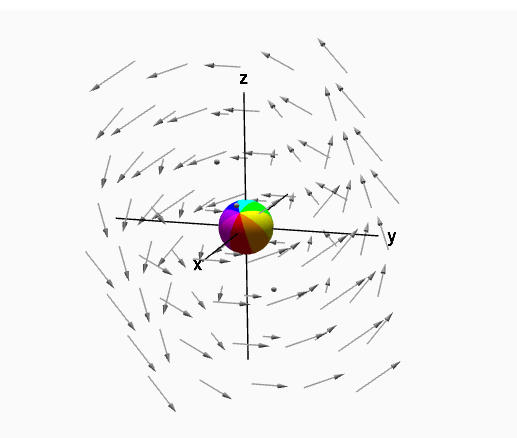
The curl of a vector field is itself a vector quantity, with both magnitude and direction.
The magnitude of curl represents the maximum rotational effect of the vector field as the enclosed area approaches zero.
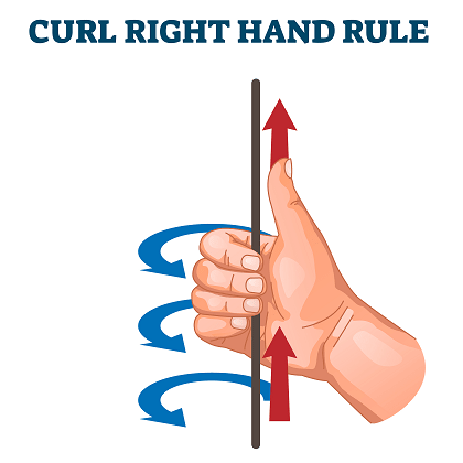
Determined using the Right-Hand Rule: curl the fingers of your right hand in the direction of rotation; the extended thumb points in the direction of the curl vector.
For a vector field:
F = P i + Q j + R k
The curl is defined as:
Curl F = ∇ × F
Where the del operator ∇ is:
$$ \nabla = \frac{\partial}{\partial x}\vec{i} + \frac{\partial}{\partial y}\vec{j} + \frac{\partial}{\partial z}\vec{k} $$
Computed via determinant:
\( \operatorname{curl} F = \left|\begin{array}{ccc} \vec{i} & \vec{j} & \vec{k} \\ \frac{\partial}{\partial x} & \frac{\partial}{\partial y} & \frac{\partial}{\partial z} \\ P & Q & R \end{array}\right| \)
Simplified as:
\( \operatorname{curl} F = \left( \frac{\partial R}{\partial y} - \frac{\partial Q}{\partial z}, \frac{\partial P}{\partial z} - \frac{\partial R}{\partial x}, \frac{\partial Q}{\partial x} - \frac{\partial P}{\partial y} \right) \)
Rotational Vector: A vector field with non-zero curl.
Irrotational Vector: A vector field with zero curl (Curl F = 0).
Given:
F = (cos(x), sin(xyz), 6x + 4)
Using the formula:
\( \nabla \times F = \left( \frac{\partial}{\partial y}(6x+4) - \frac{\partial}{\partial z}(\sin(xyz)), \frac{\partial}{\partial z}(\cos x) - \frac{\partial}{\partial x}(6x+4), \frac{\partial}{\partial x}(\sin(xyz)) - \frac{\partial}{\partial y}(\cos x) \right) \)
Evaluating partial derivatives:
$$ \operatorname{curl} F = \left( -xy\cos(xyz), -6, yz\cos(xyz) \right) $$
This result can be verified instantly using an online curl calculator.
The vector field is irrotational; it has no local rotational behavior.
Positive curl indicates counter-clockwise rotation; negative curl indicates clockwise rotation.
Divergence measures how much a vector field spreads out or converges at a point.
Curl is used extensively in electromagnetism, fluid dynamics, and vector field analysis to study rotation and circulation.
Curl quantifies the rotational behavior of vector fields. A free online curl calculator simplifies complex computations and enhances understanding of this fundamental concept in physics and engineering.
Related
Add this calculator to your site.
×Just copy a given code & paste it right now into your website HTML (source) for suitable page.
Preview:



Easter into Action, Save With Satisfaction
UPTO
50 %
OFF
Give Us Your Feedback
Share Result
Curl Calculator

Links
Home Conversion Calculator About Calculator Online Blog Hire Us Knowledge Base Sitemap Sitemap TwoEmail us at
Contact Us© Copyrights 2026 by Calculator-Online.net
