
 AI Tools
 Health
 Math
Math Everyday Life
 Finance
 Physics
 Chemistry
 Statistics
 Construction
 Pets
Pets Time & Date
 Conversion Calculator
 Sign In
Pages
Category
Follow Us On:
Pages
Category
Follow Us On:
Write down the function and point value. The calculator will instantly determine the instantaneous rate of change at the given point, providing detailed calculations.
Related
An online instantaneous rate of change calculator helps you find the instantaneous rate of change at a specific point. Use this IROC calculator to understand how the rate of change behaves at a particular value of 'x'. Read the context below to learn how to calculate the instantaneous rate of change and its formula. Let’s start with some fundamentals!
In mathematics, the instantaneous rate of change describes how a quantity changes at a specific point. It is equivalent to the derivative of a function at a given instant. Graphically, it represents the slope of the tangent line to the curve at that point. For practical purposes, you can also use a slope calculator to determine the slope between two points on a Cartesian plane.
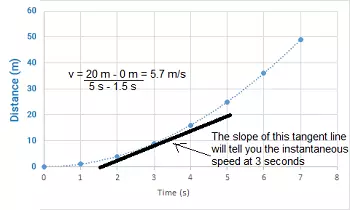
For a graph showing position versus time that is not linear, the instantaneous rate of change is found by drawing a tangent line that touches the curve at exactly one point. The slope of this tangent line gives the instantaneous rate of change at that point.
The instantaneous rate of change of a function is calculated using limits. Suppose f is a function of x. Then the instantaneous rate of change at x = a is the limit of the average rate of change over a small interval:
This represents the slope of the tangent line to y = f(x) at the point (a, f(a)). It can also be expressed using a small increment h:
When the limit exists, it is denoted as the derivative:
\( f'(a) \text{ or } \frac{df}{dx}\bigg|_{x=a} \)
Instead of manually using complex formulas, an online instantaneous rate of change calculator provides instant results. Simply fill in the input fields and calculate. Additionally, an online limit calculator helps solve limits at specific points, while an online derivative calculator differentiates functions and shows step-by-step solutions.
To calculate the instantaneous rate of change at a point, follow these steps:
Instantaneous speed cannot be measured directly because every measurement requires a finite amount of time. However, you can determine the instantaneous rate of change at a specific moment as speed and position change.
A negative instantaneous rate of change indicates that the function is decreasing at that point. For example, in a linear function f(x) = mx + b, a positive slope (m) represents an increasing function, while a negative slope represents a decreasing function.
It is also called the differential coefficient or fluxion.
The average rate of change measures change over an interval, while the instantaneous rate of change measures it at a specific point. An instantaneous rate calculator can compute this directly.
The Instantaneous Rate of Change Calculator is designed for educational purposes. It provides quick and accurate calculations, reduces errors in complex problems, and helps you understand the rate of change at specific points efficiently. Try it to learn faster and more effectively!
From Wikipedia: Rate of change. For more detailed explanations, see Brightstorm: Concept and Toppr: solved questions and examples.
Related
Add this calculator to your site.
×Just copy a given code & paste it right now into your website HTML (source) for suitable page.
Preview:



Easter into Action, Save With Satisfaction
UPTO
50 %
OFF
Give Us Your Feedback
Share Result
Instantaneous Rate of Change Calculator

Links
Home Conversion Calculator About Calculator Online Blog Hire Us Knowledge Base Sitemap Sitemap TwoEmail us at
Contact Us© Copyrights 2026 by Calculator-Online.net
