
 AI Tools
 Health
 Math
Math Everyday Life
 Finance
 Physics
 Chemistry
 Statistics
 Construction
 Pets
Pets Time & Date
 Conversion Calculator
 Sign In
Pages
Category
Follow Us On:
Pages
Category
Follow Us On:
Enter the required elements to calculate the total, inward, and outward flux enclosed in a closed surface using this calculator.
Related
This advanced electric flux calculator helps you calculate the electric flux produced by an electric charge. It considers surface area and the angle of the flux to compute the inward, outward, and total flux crossing a given surface.
Electric flux represents the total number of electric field lines passing through a given surface area.
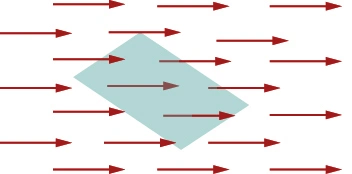
You can calculate electric flux using Gauss’s Law, which is a fundamental principle for determining how much flux passes through a surface.
Statement: “The total electric flux through a closed surface is directly proportional to the charge enclosed within it and inversely proportional to the permittivity of free space.”
𝜙 = Q / ε₀
Where:
The total charge can also be calculated using: Total Charge = 𝜙 × ε₀
Example: Suppose the charge enclosed by a surface is Q = 1.05 × 10² C. What is the electric flux through the surface?
Using Gauss’s Law:
𝜙 = Q / ε₀
𝜙 = (1.05 × 10²) / (8.85 × 10⁻¹²)
𝜙 = 105 / 0.00000000000885
𝜙 ≈ 1.05 × 10¹⁴ N·m²/C
This represents the electric flux passing through the surface and can also be verified using the electric flux calculator.
No, electric flux depends on the density of field lines passing through the surface and the angle between the field and the surface.
Electric flux is a scalar quantity. Although it is calculated as the dot product of two vectors (electric field and area vector), the result is always scalar.
Common types of flux include:
Related
Add this calculator to your site.
×Just copy a given code & paste it right now into your website HTML (source) for suitable page.
Preview:



Easter into Action, Save With Satisfaction
UPTO
50 %
OFF
Give Us Your Feedback
Share Result
Electric Flux calculator

Links
Home Conversion Calculator About Calculator Online Blog Hire Us Knowledge Base Sitemap Sitemap TwoEmail us at
Contact Us© Copyrights 2026 by Calculator-Online.net
