
 AI Tools
 Health
 Math
Math Everyday Life
 Finance
 Physics
 Chemistry
 Statistics
 Construction
 Pets
Pets Time & Date
 Conversion Calculator
 Sign In
Pages
Category
Follow Us On:
Pages
Category
Follow Us On:
Select the parameters and enter their values. The calculator will instantly determine voltage, current, and other transformer-related terms.
Related
The transformer calculator allows you to compute the primary and secondary voltages and full-load currents (Amps) for both single-phase and three-phase transformers. It works for ideal and real transformers, determines transformer type from the turns ratio, and helps estimate EMF and transmission losses, including:
A transformer is an electrical device that transfers AC power from one circuit to another. It operates on Faraday’s Law of Electromagnetic Induction and can either step up or step down voltage levels.
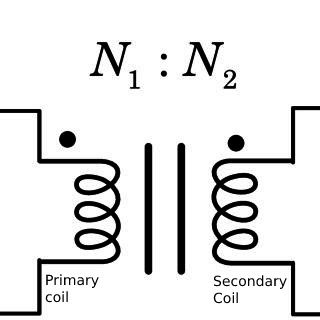
The transformer calculator uses the following formulas to model its electrical behavior.
\(V_p = \frac{N_p}{N_s} \times V_s\)
Where:
\(I_s = I_p \times \frac{N_p}{N_s}\)
\(Full\text{-}Load\ Current\ (Amps) = \frac{kVA \times 1000}{V}\)
\(Full\text{-}Load\ Current\ (Amps) = \frac{kVA \times 1000}{\sqrt{3} \times V}\)
\(Turns\ Ratio = \frac{N_1}{N_2} = \frac{V_1}{V_2} = \frac{I_2}{I_1}\)
Consider a single-phase transformer rated at 56 kVA, with a primary voltage of 350 V and a secondary voltage of 120 V. Calculate the turns ratio and full-load currents for an ideal transformer.
Turns ratio:
\(Turns\ Ratio = \frac{V_1}{V_2} = \frac{350}{120} \approx 2.917\)
\(I_p = \frac{56 \times 1000}{350} \approx 160 \text{ Amps}\)
\(I_s = \frac{56 \times 1000}{120} \approx 466.67 \text{ Amps}\)
Related: Always consider calculating Voltage Drop and Amperage across circuits for accurate transformer analysis.
To size a transformer, multiply the required load current by the secondary voltage:
Note: Do not load a transformer above 80% of its KVA rating. To find the minimum KVA needed, divide the calculated VA by 0.8. Always confirm values with a licensed electrician or electrical engineer.
A rectifier converts AC into DC voltage for industrial and chemical processes, such as:
kW measures real power delivered, while kVA measures apparent power, which includes both real and reactive power.
With a primary voltage of 480 V and secondary of 120/240 V, a 150 kVA transformer can handle roughly 400 Amps on the secondary side, depending on the load and conductor.
Related
Add this calculator to your site.
×Just copy a given code & paste it right now into your website HTML (source) for suitable page.
Preview:



Easter into Action, Save With Satisfaction
UPTO
50 %
OFF
Give Us Your Feedback
Share Result
Transformer Calculator

Links
Home Conversion Calculator About Calculator Online Blog Hire Us Knowledge Base Sitemap Sitemap TwoEmail us at
Contact Us© Copyrights 2026 by Calculator-Online.net
