
 AI Tools
 Health
 Math
Math Everyday Life
 Finance
 Physics
 Chemistry
 Statistics
 Construction
 Pets
Pets Time & Date
 Conversion Calculator
 Sign In
Pages
Category
Follow Us On:
Pages
Category
Follow Us On:
Enter the required parameters, and the calculator will instantly estimate the orbital period.
Related
Use this orbital period calculator to estimate the time required for a satellite or binary system to complete one full orbit. The calculator uses parameters such as central body density, semi-major axis, and the masses of the orbiting bodies to predict the orbital period.
"The time required for an object or satellite to complete one full revolution around another larger object is called the orbital period."
This concept applies to celestial bodies such as planets orbiting stars, moons orbiting planets, or satellites orbiting Earth. The orbital period is governed by Kepler’s Laws of Planetary Motion.
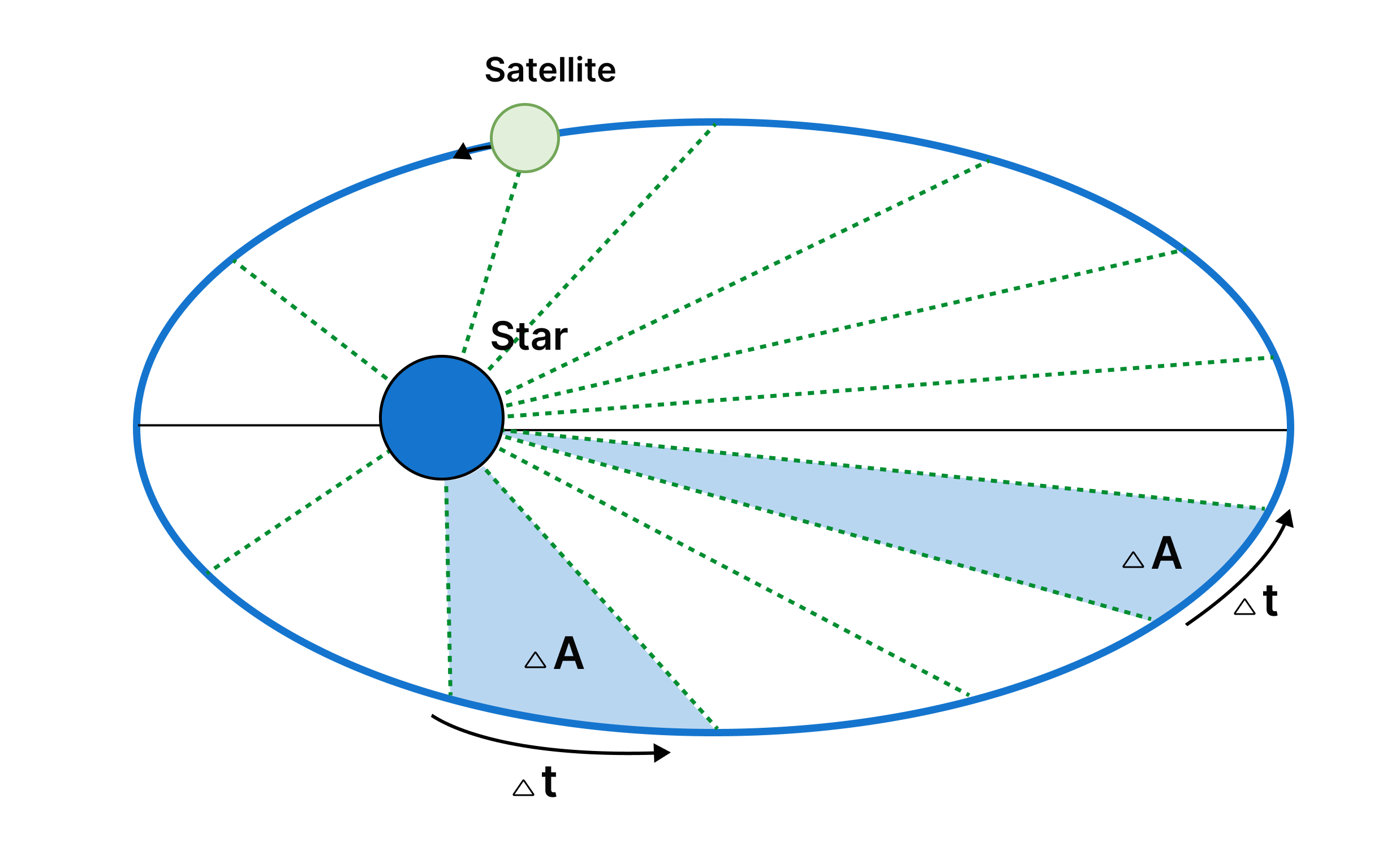
1. Low Earth Orbit (LEO):
This orbit lies close to Earth's surface. In this case, the orbital period can be calculated using the mean density of the central body.
2. Binary Star System:
In a binary system, two bodies of comparable masses orbit around their common center of mass.
\(T = \sqrt{\dfrac{3\pi}{G \cdot \rho}}\)
\(T_b = 2\pi \sqrt{\dfrac{a^3}{G (M_1 + M_2)}}\)
Given:
Step 1: Convert to kg/m³
\(\rho = 6.51 \times 1000 \times \left(\dfrac{1}{100}\right)^3 = 6510 \text{ kg/m³}\)
Step 2: Use gravitational constant
\(G = 6.67 \times 10^{-11} \text{ m³·kg⁻¹·s⁻²}\)
Step 3: Apply formula
\(T = \sqrt{\dfrac{3\pi}{(6.67 \times 10^{-11}) \cdot 6510}}\)
After calculation:
\(T ≈ 4662.08 \text{ seconds}\)
Convert to hours:
\(T = \dfrac{4662.08}{3600} ≈ 1.295 \text{ hours}\)
Given:
Step 1: Apply formula
\(T_b = 2\pi \sqrt{\dfrac{a^3}{G(M_1 + M_2)}}\)
Step 2: Substitute values
\(T_b = 2\pi \sqrt{\dfrac{5^3}{(6.67 \times 10^{-11})(50)}}\)
\(5^3 = 125\)
\(G(M_1 + M_2) = 3.335 \times 10^{-9}\)
\(\dfrac{125}{3.335 \times 10^{-9}} ≈ 3.746 \times 10^{10}\)
\(\sqrt{3.746 \times 10^{10}} ≈ 193490.7\)
Step 3: Multiply by \(2\pi\)
\(T_b ≈ 1,218,097 \text{ seconds}\)
Convert to hours:
\(T_b ≈ 338.3 \text{ hours}\)
Related
Add this calculator to your site.
×Just copy a given code & paste it right now into your website HTML (source) for suitable page.
Preview:



Easter into Action, Save With Satisfaction
UPTO
50 %
OFF
Give Us Your Feedback
Share Result
Orbital Period Calculator

Links
Home Conversion Calculator About Calculator Online Blog Hire Us Knowledge Base Sitemap Sitemap TwoEmail us at
Contact Us© Copyrights 2026 by Calculator-Online.net
